A Dangerous Trap
The popular front in history & theory


The following is an edited version of a speech by a Bolshevik Caucus supporter on 13 April 2026 as part of a series of talks on “Cross-Class Coalitions: History & Theory”, republished from bolshevik.org.
A video of the full meeting is also available.
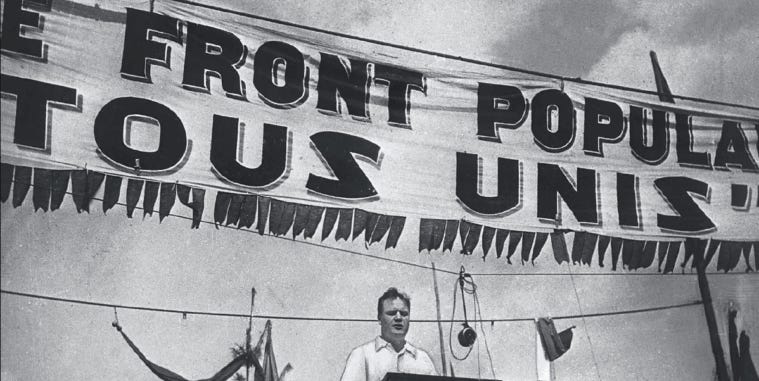
The popular front is defined as an alliance between workers’ parties and parties of the “progressive” wing of the bourgeoisie or petty bourgeoisie. It differs from the united front, which is an alliance between workers’ organisations with different programmes but common interests around immediate demands. The united front is a key tool for the workers movement. The popular front is a dangerous trap.
I’m going to speak today mainly about its use by the Stalinists in the 1930s, when it was first called the popular front, but this type of cross-class coalition goes back further than that and has occurred many times since. Throughout this history, we see time after time that cross-class alliances tie the working class to capitalism and lead to defeat, often very bloody defeat. This is really important for us to understand today.
Russia
I’m going to start with a more positive story about the popular front—or rather how it was broken, which led to the most successful workers’ revolution in history, in Russia in October 1917. After the Tsar was overthrown in the February Revolution, the bourgeois Provisional Government was established, and was joined or supported by most of the workers’ organisations, not believing it was yet time to take power—even the Bolsheviks, at first. However, the country saw a situation of dual power with the government on the one hand and the soviets of workers, peasants and soldiers on the other. Soviets are an expression of the united front in pre-revolutionary situations: alliances of workers’ organisations, competing for political leadership. But dual power is a contradictory and unstable situation—it must eventually resolve one way or the other.
A fight took place within the Bolshevik Party, led by Lenin and culminating in the adoption of the slogan “Down with the ten capitalist ministers”—a call to break the popular-frontist Constituent Assembly, split it along class lines. This was world-changing, a decision that allowed the Bolsheviks to build an independent pole, win the majority in the workers’ soviets and take power in October. Without this, the most likely outcome was a victory for Kornilov and the White generals, a regime of terror and imperialist domination of Russia. Trotsky once claimed that, if this had happened, the word for fascism would be Russian, not Italian.
So it is clear that when the Stalinists adopted the policy of the popular front in the 1930s, this was in direct contradiction to Bolshevism, to the history they claimed to uphold. Their right-turn to popular frontism was in reaction to the ultra-left policies of the Third Period. The German Stalinists essentially handed over state power to Hitler by refusing to form a united front with the Social Democrats (who they called social-fascists). So that is also, I would add, a policy contrary to Bolshevism.
France
The name Front Populaire was first used by the Stalinists in France, to justify a bloc between the communist PCF, the Socialist Party and the bourgeois Radicals. The Communist and Socialist Parties had broken the stalemate of the Third Period to organise huge trade-union demonstrations and strikes in response to a fascist attack on parliament in February 1934—by a group called Cross of Fire. The Radicals joined them in July 1935 and the coalition took power the following March, with a cabinet of Socialists and Radicals, with the less respectable Communists supporting from the side.
The French workers saw this as a victory and responded with the general strike of May/June 1936. But the bourgeoisie panicked—that wasn’t at all what they had intended! They appealed to their bloc partners in the workers’ parties who obligingly negotiated an end to the strike. The Communist Party’s Maurice Thorez assured his masters that “there can be no question of taking power at this time” and lectured the workers that “one must know how to end a strike”.
Their job of demoralising the working class completed, the communists and socialists were ditched and the popular front was replaced by a Radical government under Edouard Daladier in 1938. Reforms were reversed—eg, the 40-hour week reverting back to 48 hours. The PCF called a one-day strike. Disgusted by this timidity, workers tore up their union cards. Daladier declared martial law, banned the PCF and the CGT (the communist-linked trade union). It was a quick descent from there to the establishment of the pro-Nazi Vichy regime in 1940.
Spain
A similar process was taking place in Spain around the same time, against the background of the Spanish Civil War. A bourgeois republic was established in 1931 after the overthrow of the monarchy, but not a lot changed for the working class.
In October 1934 this boiled over into an insurrectionary movement in the mining region of Asturias, harshly repressed by the government, and the formation of workers’ committees. Just as in France, the bourgeoisie sought ways to contain working-class struggle by co-opting the leadership.
This led to the Popular Front government in February 1936, made up of socialist, republican and nationalist parties, the Communist Party and the POUM. The latter has an interesting history, being formed by a fusion between Trotskyists, led by Andreu Nin, and the syndicalist Workers and Peasants Bloc. Nin had been a personal friend of Trotsky, who put a lot of energy into persuading him not to join the popular front, to no avail. The popular front explicitly agreed not to advocate nationalisation of land, or of the banks, or for workers control.
The working class differed, and (as in France) responded to the election of what they perceived as “their” government with class struggle—factory and land occupations.
The Civil War began in response to this, with a rebellion of generals led by Francisco Franco, starting in Morocco and taking over about half the country in July 1936. Azana’s popular front government attempted to negotiate and refused to arm the workers, until forced to do so when the workers (led by the POUM and anarchists) formed militias and fought anyway. The militias took over Barcelona and established collective farms in surrounding areas. The Popular Front government was put under military footing under Caballero, and there was also a regional popular-frontist government established in Catalonia. Like Russia between February and October, it was a situation of dual power.
But here, there was no Lenin. Again, all the workers’ parties, including the POUM and even representatives of the anarchist CNT, joined the popular front. By doing so, these workers’ organisations participated in setting the conditions for defeat. Like their French cothinkers, the Stalinists deliberately limited their objectives, declaring: “the Spanish people are not striving for the establishment of the dictatorship of the proletariat, but know only one aim: the defense of the republican order while respecting private property.”
Workers were disarmed, their press was censored, their organisations were banned. In a key incident of the war, the Stalinists attacked the telegraph exchange in Barcelona, held by the militias—a provocation then used to attack the workers. Despite the POUM accepting a truce, their leaders were arrested (and later shot). The collective farms and workers’ militias were dissolved.
Franco won the war against a now demoralised and disarmed working class. The Stalinist tactic of the popular front had once again handed power to the far-right wing of the bourgeoisie. There was a very small group of Trotskyists calling to organise outside the popular front, but the POUM, which could have been influential, chose to go along with the popular front, because it was popular.
World War II
Why were the Stalinists doing this? The answer lies in the period we are discussing, the build up to World War II: a period of capitalist crisis, in which politics polarises towards the far left and the far right, and class distinctions take on even more significance. Even the liberal bourgeoisie, fearful of working-class power and threats to its property, would rather the far right than the far left. The Stalinists in the Soviet Union, a bureaucratic caste presiding over a degenerated workers’ state, were also fearful of the working class, as were the trade-union leaders (Stalinist and social-democrat) in the liberal democracies. For the Stalinists to support working-class revolution abroad would run the risk of the same happening in the Soviet Union, but they needed allies to defend “socialism in one country”. Enter the liberal bourgeoisie in the west, the governments of Britain, France etc. The popular front represented the common interests of these groups.
In Britain, the trade-union leaders (Labour and Communist) agreed to no-strike policies during the war, committed to “defence of the fatherland”. Winston Churchill brought the Labour Party into his wartime cabinet in order to better control the trade unions. Both are forms of the popular front or could more broadly be described as class collaboration.
The task of revolutionaries during inter-imperialist war is working for the defeat of our own ruling class. Strikes are exactly what is needed, plus blockage of arms, and rebellion within the conscripted armed forces. Class-struggle tactics, not popular fronts, were needed in WWII and are needed today, against the inter-imperialist war between Russia and NATO-backed Ukraine, and in defence of Iran, Lebanon and the Palestinians against our government’s US and Israeli allies. The liberal bourgeoisie (Lib Dems, Greens, CND etc) should not be turned away from anti-war protests, but an anti-war movement designed to be comfortable for the capitalist class is not the kind of anti-war movement we need.
Other Examples of the Popular Front
Spain and France in the 1930s are not the only examples where the popular front has been literally fatal to the working class and has sidelined potential revolutionary movements.
The decade before, in China, Stalin instructed the Communist Party to enter the bourgeois nationalist Kuomintang, rather than separately organising growing class-struggle. They were rewarded for their loyalty by being slaughtered by Chiang Kai-Shek in Shanghai and elsewhere.
In Chile in the early 1970s, Salvador Allende insisted on sharing power with a small bourgeois party, using it as an excuse not to provide arms to the workers who were desperately calling for them in the face of right-wing threats, culminating in Pinochet’s bloody victory. The same policies are being carried out in Chile today by Gabriel Boric.
In South Africa under apartheid, the Communist Party joined the bourgeois nationalist ANC to ensure that the working-class resistance to apartheid led to a bourgeois government with apartheid removed de jure but not de facto. Huge racial inequalities remain, alongside other problems that capitalism cannot solve. The Economic Freedom Fighters (EFF) today argue to return to the Freedom Charter and the old days of the ANC, but again are not a working-class party.
Recently in France we saw the explicit revival of the 1930s popular front in the Nouveau Front Populaire (Mélenchon’s La France Insoumise, the PCF, the decimated Socialist Party and the Greens). They were very successful in the first round of the election in 2024, yet in the second round stood down in many seats to support the candidate of Macron against that of Le Pen. Macron rewarded them by forming alliances with the right, denying the NFP the chance to form a government, despite being the largest party in parliament. We may not be seeing mass murder of communists, but the French far-right are openly carrying out attacks on immigrants, without the inconvenience of a clear independent working-class opposition.
And here in Britain, we are experiencing a monumental failure to build an independent working-class party, even one with a social-democratic programme. Disillusioned former members of Your Party are joining the Greens, as are many others—deceptively led by Polanski’s left rhetoric on social issues into a party that supports British imperialism, local budget cuts and overall the interests of capitalism, with a green gloss. Within Your Party, the national leadership (and both Corbyn and Sultana) promote alliances with the Greens, and there is often collaboration at the local level.
Reform are top of the polls, and the SWP are out campaigning under the slogan “use your vote to Stop Reform”, in many places an explicit call to vote Green. Meanwhile they present the Together Alliance’s class-free mantras of Love, Hope and Unity as the solution to the far right. This is the popular front in non-governmental form.
Historical parallels are never perfect, but there is a distinct pattern in all the examples I’ve cited today. The far-right is fed by capitalism in crisis—we do not fight it by opting for a nicer kind of capitalism or endorsing those who advocate that. That leads to a disarmed working class—literally and ideologically—and an even more emboldened far right.
There is much to discuss about what we need to do next, but this discussion must take place alongside united-front action against threats to the working class, based on independent working-class organisation and class-struggle methods. Only on this basis will we move towards the revolutionary party that is so badly needed.
Related articles
It’s All About Class: Not Green eco-populism but working-class socialism (speech at an earlier meeting in the series, 16 March 2026)
Popular-Front Betrayal in France: The Nouveau Front Populaire & the far left (1917 No.48)
Pink Tides & Popular Fronts: Revolutionary Strategy in Latin America (1917 No.47)
 | A guest post by
|